English has a funny way of confusing even confident writers. One tiny space can completely change whether something looks polished or painfully incorrect. That’s exactly what happens with “of course” and “ofcourse.”
You’ve probably seen both versions online. Maybe someone typed it quickly in a text message. Maybe autocorrect missed it. Or perhaps you paused mid-email wondering:
Is “ofcourse” correct?
Short answer? No.
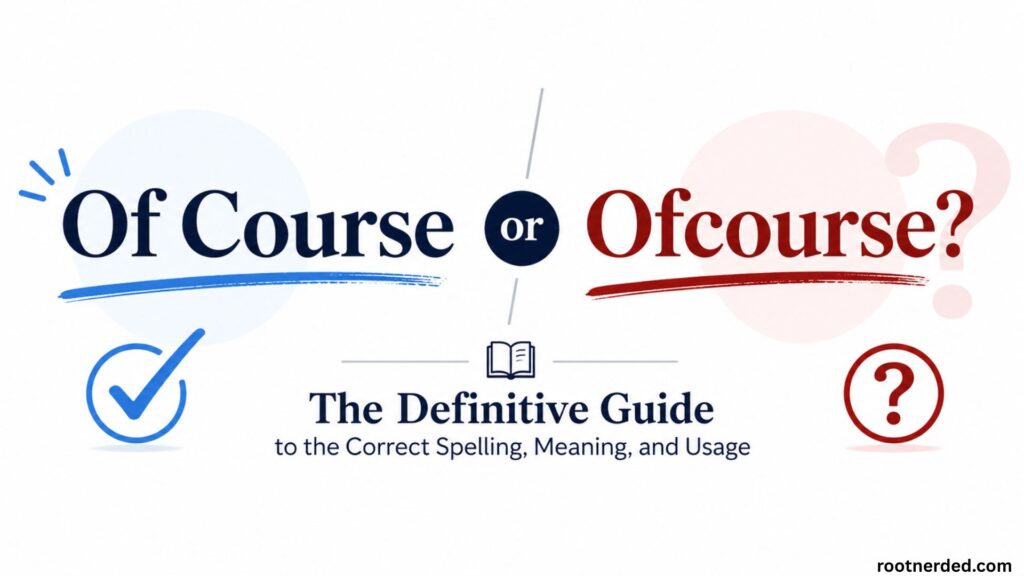
The correct spelling of of course is always written as two separate words: of course.
Still, there’s more to this phrase than simple spelling. Understanding of course meaning, punctuation, tone, grammar, and context can dramatically improve your writing clarity and professionalism.
So let’s settle the of course vs ofcourse debate once and for all.
Understanding “Of Course” Meaning
At its core, “of course” is an idiomatic English expression used to show:
- Agreement
- Reassurance
- Permission
- Obviousness
- Certainty
It’s one of the most common phrases in conversational English and appears constantly in:
- Business emails
- Academic writing
- Casual chats
- Professional communication
- Online content writing
Simple Examples
- “Of course I’ll help you.”
- “You can borrow my laptop, of course.”
- “Of course she remembered the meeting.”
In each sentence, the phrase adds warmth, certainty, or emphasis.
Think of it as the verbal equivalent of a friendly nod.
Is “Ofcourse” Correct?
Here’s the important part:
“Ofcourse” is incorrect in standard English.
There’s no recognized dictionary entry for it in proper grammar references or professional writing guides.
If you write “ofcourse” in:
- Academic papers
- Corporate memos
- Assignment submissions
- Client communication
- Professional emails
…it may hurt your credibility in writing.
That’s why many English learners search for:
- what is the correct spelling of of course
- why is ofcourse wrong
- is ofcourse acceptable in English
The answer remains consistent across modern English grammar rules:
✅ Of course
❌ Ofcourse
Why Do People Write “Ofcourse”?
This mistake happens more often than you’d think.
1. Fast Typing Habits
People combine words while texting quickly. Similar mistakes include:
- alot → a lot
- atleast → at least
- infact → in fact
2. Autocorrect Failures
Sometimes phones don’t catch the error. That leads people to assume it’s acceptable.
3. Confusion With Compound Words
English contains many compound words like:
- notebook
- toothpaste
- classroom
So writers naturally wonder whether “ofcourse” should also be one word.
However, “of course” remains a two-word phrase because it functions differently in sentence structure.
Of Course Grammar Explained
To understand of course grammar, you need to know how the phrase works grammatically.
The expression combines:
- “of” → a preposition
- “course” → a noun
Together, they form a fixed idiomatic phrase.
It doesn’t behave like a standard compound word.
That’s why dictionaries and style guides keep the space intact.
Difference Between “Of Course” and “Ofcourse”
Here’s a quick comparison table for clarity.
| Phrase | Correct? | Usage |
|---|---|---|
| Of course | ✅ Yes | Proper English phrase |
| Ofcourse | ❌ No | Common spelling mistake |
The difference between of course and ofcourse is simple:
One follows standard English spelling rules. The other doesn’t.
When to Use “Of Course”
One reason this phrase survives in everyday speech is flexibility. You can use it in formal writing, casual chats, or friendly responses.
Showing Agreement
“Will you attend the conference tomorrow?”
“Of course.”
Giving Permission
“Can I use your charger?”
“Of course you can.”
Expressing Reassurance
“Are you sure the presentation will be ready?”
“Of course. I finished it yesterday.”
Stating the Obvious
“Did Emma bring coffee again?”
“Of course she did.”
The phrase often softens communication and makes responses sound warmer.
Is “Of Course” Formal or Informal?
Interestingly, it works in both.
In Formal Writing
You’ll often see it in:
- Business English phrases
- Professional communication
- Academic English spelling examples
- Workplace writing
Example:
“Of course, the final proposal must receive approval before publication.”
In Informal Writing
Friends use it constantly in messages and social media.
Example:
“Of course I’m coming to the party 😂”
That versatility makes it one of the most useful conversational English phrases in the language.
Of Course Punctuation Rules
Many people struggle with of course punctuation and comma placement.
Here’s the good news: the rules are pretty straightforward.
When to Use a Comma After “Of Course”
Use a comma when the phrase introduces a sentence.
Examples
- “Of course, you’re welcome to join us.”
- “Of course, Liam forgot his umbrella again.”
This improves readability and sentence flow.
When You Don’t Need a Comma
If the phrase appears naturally within a sentence, commas may not be necessary.
Examples
- “You can of course contact me later.”
- “She will of course explain everything tomorrow.”
This depends on tone and emphasis.
That’s why context-based meaning matters so much in English expression.
Of Course in a Sentence: Natural Examples
Here are several examples showing different tones and situations.
Friendly Tone
“Of course I remembered your birthday.”
Professional Tone
“Of course we appreciate your feedback regarding the project.”
Sarcastic Tone
“Oh, of course the printer stopped working five minutes before the meeting.”
Neutral Tone
“Of course the data must be verified first.”
Notice how tone interpretation changes depending on context.
Same phrase. Completely different emotional flavor.
Business Email Example Using “Of Course”
Here’s a realistic example showing proper professional usage.
Hi Daniel,
Thank you for sending the updated schedule.
Of course, I’ll attend Thursday’s strategy meeting at 2 PM. I’ve also reviewed the marketing notes and added a few suggestions to the shared document.
Please let me know if you need anything else before the presentation.
Best regards,
Sophia Bennett
This sounds polished, natural, and professional.
Using “ofcourse” here would immediately look careless.
Casual Chat Example
Here’s how native speakers naturally use the phrase in texting.
Mia: Hey, can you help me study tonight?
Jordan: Of course! I’ll call you around 7 😊
Short. Friendly. Completely natural.
Why “Ofcourse” Looks Unprofessional
Small spelling errors create surprisingly large impressions.
In business settings, clients often judge attention to detail based on writing quality.
Misspelling a common phrase can make communication appear:
- Rushed
- Unedited
- Inexperienced
- Less credible
That’s why understanding professional writing spelling matters.
A tiny missing space may not ruin a sentence. However, repeated mistakes can weaken trust.
Common English Spelling Mistakes Similar to “Ofcourse”
English learners frequently combine phrases incorrectly.
Here are a few examples:
| Incorrect | Correct |
|---|---|
| alot | a lot |
| atleast | at least |
| infact | in fact |
| aswell | as well |
| ofcourse | of course |
These errors usually happen because spoken English flows quickly.
Unfortunately, written English still follows traditional spelling rules.
How Native Speakers Use “Of Course”
Native speakers use this phrase constantly because it feels warm and natural.
Instead of sounding robotic, it adds personality.
Compare these two responses:
Robotic
“Yes. You may proceed.”
Natural
“Of course, go ahead.”
The second version sounds more human and approachable.
That’s why the phrase appears frequently in:
- Customer service
- Workplace writing
- Client communication
- Dialogue writing
- Social media replies
Can “Of Course” Sound Rude?
Surprisingly, yes.
Tone changes everything.
Polite Example
“Of course, I’d be happy to help.”
Annoyed Example
“Of course you forgot the tickets.”
Sarcastic Example
“Yeah, of course that happened.”
English relies heavily on context and vocal tone. The exact same phrase can sound reassuring or irritated.
That’s part of the beauty of natural English phrases.
Easy Trick to Remember the Correct Spelling
Here’s a simple memory trick:
If you can replace the phrase with:
- naturally
- certainly
- definitely
…then write it as two words.
Example
“Of course I’ll help.”
→ “Certainly I’ll help.”
Since it functions as a phrase rather than a compound word, the correct version stays separated.
Final Verdict: Of Course or Ofcourse?
Let’s make it crystal clear.
The correct spelling is always:
✅ Of course
The incorrect version is:
❌ Ofcourse
No major dictionary, grammar guide, or academic style manual accepts “ofcourse” as standard English.
Whether you’re writing:
- Business emails
- Academic papers
- Online articles
- Social media captions
- Professional communication
…you should always use “of course.”
That single space matters more than people think.
Final Thoughts
English contains countless tiny traps. This one catches both learners and native speakers surprisingly often.
Still, mastering small details like of course spelling, punctuation, and usage instantly improves your writing professionalism.
And honestly? That’s the difference between writing that merely communicates and writing that feels polished, confident, and natural.
So next time you pause and wonder:
“Of course or ofcourse?”
You’ll know exactly which version belongs on the page.